
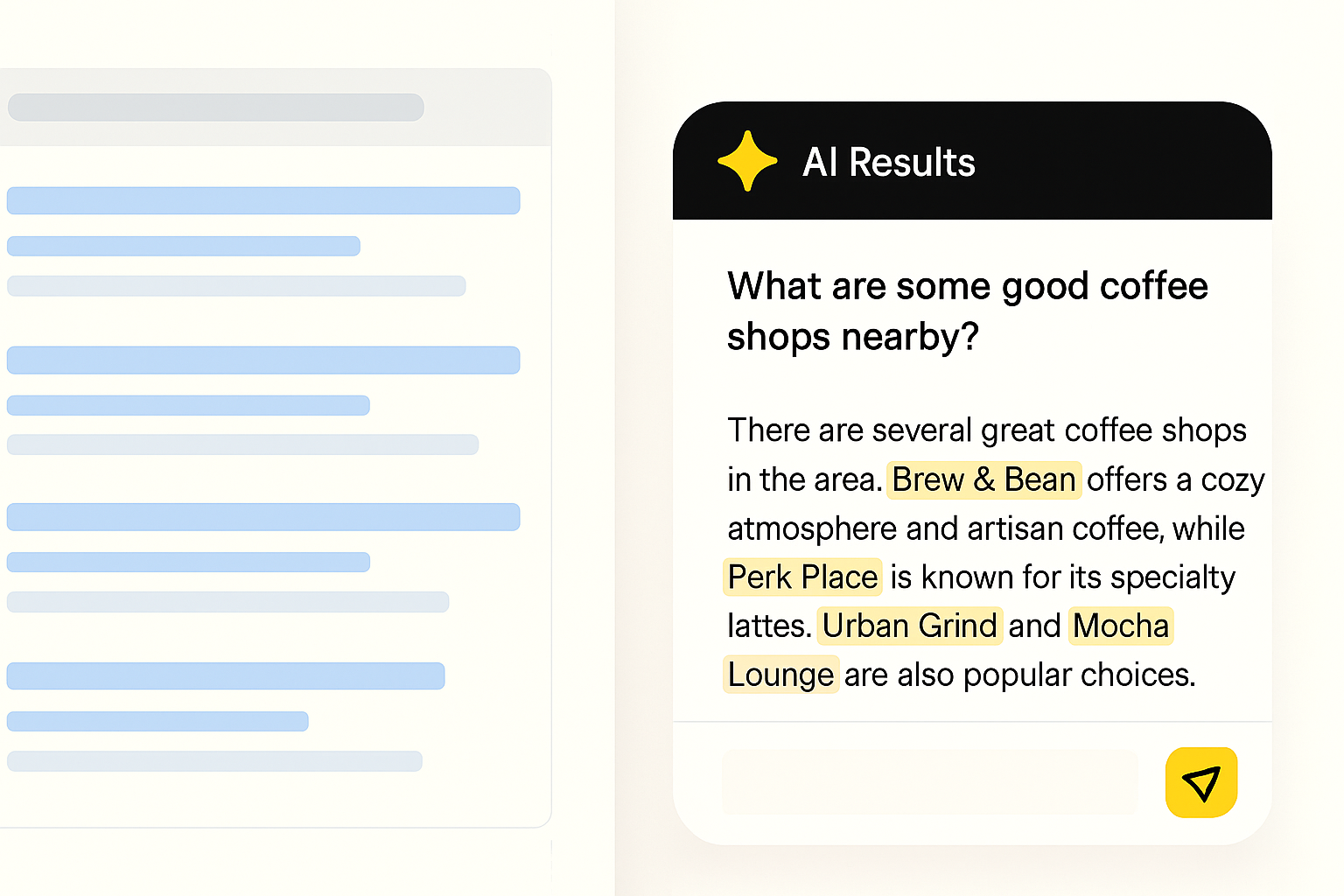
Something fundamental has shifted in how people find businesses online, and it happened so quietly that most small and medium businesses haven't noticed yet.
About half of US consumers now use AI-powered search tools like ChatGPT, Perplexity, and Google's AI Overviews when researching purchases, according to recent data from McKinsey. Instead of clicking through ten blue links on Google, they're asking conversational questions and getting synthesized answers—complete with recommendations—without ever visiting a search results page.
The question is: when AI tools answer questions in your industry, does your business get mentioned? Or are your competitors the ones being recommended?
This isn't hypothetical. It's happening right now, and it's created an entirely new discipline called Generative Engine Optimization (GEO) - the practice of ensuring your business shows up when AI systems generate answers about your industry.
The good news? The platforms themselves - Google, Microsoft, and Perplexity -recently shared practical advice on how to adapt, and it's more accessible than you might think.
What You Can Do Right Now
Before we dive into the details, here are five actionable steps you can take this week to improve your visibility in AI-powered search:
- Clean up your basics. Ensure your website has proper structured data (the code that helps AI understand your content) and a clear sitemap. Google's free Structured Data Helper makes this straightforward.
- Add FAQ sections. Create a dedicated FAQ page or add question-and-answer sections to your service pages. AI systems love clear, direct answers to common questions.
- Incorporate images and video. If your website is text-only, start adding relevant visuals. AI is getting better at multimodal content, and Google specifically noted this as increasingly important.
- Write for humans, not algorithms. The platforms all emphasized this: create genuinely useful content. Danny Sullivan from Google said it this way: "Are you doing things that are useful for human beings? That's what we want to reward."
- Update your "About" page. Add clear author bios with credentials and expertise. AI engines prioritize content with transparent authorship and authority signals.
Why This Matters More Than You Think
Traditional search isn't going anywhere - Google still dominates with 90% market share - but the way people search is evolving. When someone asks ChatGPT, "What's the best marketing agency for small businesses in San Diego?" they're not looking for ten options to evaluate. They want a direct recommendation, delivered conversationally, right now.
Research shows that AI-referred visitors convert at 2.3 times the rate of traditional organic search traffic. Why? Because AI pre-qualifies them. By the time they click through to your site, they've already been told you're a credible option.
The challenge is that AI systems typically cite only 2-7 sources per response, far fewer than Google's traditional ten results. If you're not one of those handful of citations, you're invisible to a rapidly growing segment of potential customers.
What the Platforms Are Saying
The recent advice from Google, Microsoft, and Perplexity converges on a few key themes:
From Google: The fundamentals of good SEO still matter. Danny Sullivan emphasized that structured data, clean site architecture, and quality content remain foundational. What's new is the importance of multimodal content - adding images and videos alongside text helps AI understand and reference your content more effectively.
From Microsoft: Krishna Madhavan at Bing stressed that you need to think beyond keywords to user intent and question-answer structure. Format matters: use lists, tables, and clear Q&A sections. Keep punctuation simple (avoid em dashes and symbols that confuse parsing). The goal has shifted from optimizing for a spot on a results page to optimizing for inclusion in a synthesized answer.
From Perplexity: Jesse Dwyer warned against simply transferring your SEO playbook to GEO without adaptation. He also made a fascinating prediction: AI search will shift marketing budgets back toward brand building. When AI removes the "friction" of search, strong brands win. People buy by asking, and AI recommends what it recognizes.
The Deeper Strategy
According to many analyses, successful GEO requires focusing on six areas:
- Content depth over keyword matching - comprehensive, valuable information wins
- Clear structure - executive summaries, logical sections, and closing takeaways help AI extract information
- Brand mentions across the web - citations from third-party sites carry more weight than your own claims
- Data and statistics - specific numbers outperform vague statements
- Demonstrated expertise - precise, technical language (without marketing fluff) signals authority
- Rich content formats - videos, images, and interactive elements enhance AI understanding
The encouraging news is that these practices overlap significantly with good SEO. Semactic notes that "successful brands will be those that know how to optimize simultaneously for traditional search engines and AI engines." You're not starting from scratch - you're building on what already works.
The Window Is Now
Here's the reality: we're in an early-mover window. Most businesses haven't adapted yet. The ones who optimize now will establish visibility patterns that compound over time - AI systems tend to reinforce sources they've already deemed credible.
But this isn't about chasing the latest trend. It's about recognizing a fundamental shift in how your customers find information and making sure you're part of that conversation.
The platforms themselves are giving us the playbook. The question is whether we'll use it.
Let's Talk About Your Visibility
At Avenir Thinking, we're working with clients to understand where they show up - or don't - in AI-generated responses about their industries. Sometimes it's a simple fix: adding structured data, reorganizing content for clarity, or building the right kind of external mentions. Sometimes it's a bigger strategy shift.
Want to know how your business appears in AI search? We can run a visibility audit and show you exactly where you stand and what opportunities exist to improve your positioning. Get in touch and let's start a conversation about what this means for your business.
Sources cited:
- Business Insider: "Google, Microsoft, and Perplexity share tips on how to boost your brand's visibility in AI searches" (December 1, 2025)
- Semactic: "Generative Engine Optimization: 6 tips for integrating GEO into your 2025 strategy"
- Promptmonitor: "Complete Guide to Generative Engine Optimization (GEO) 2025"